Zanzibar Spice Quality & Buyer Specification Guide
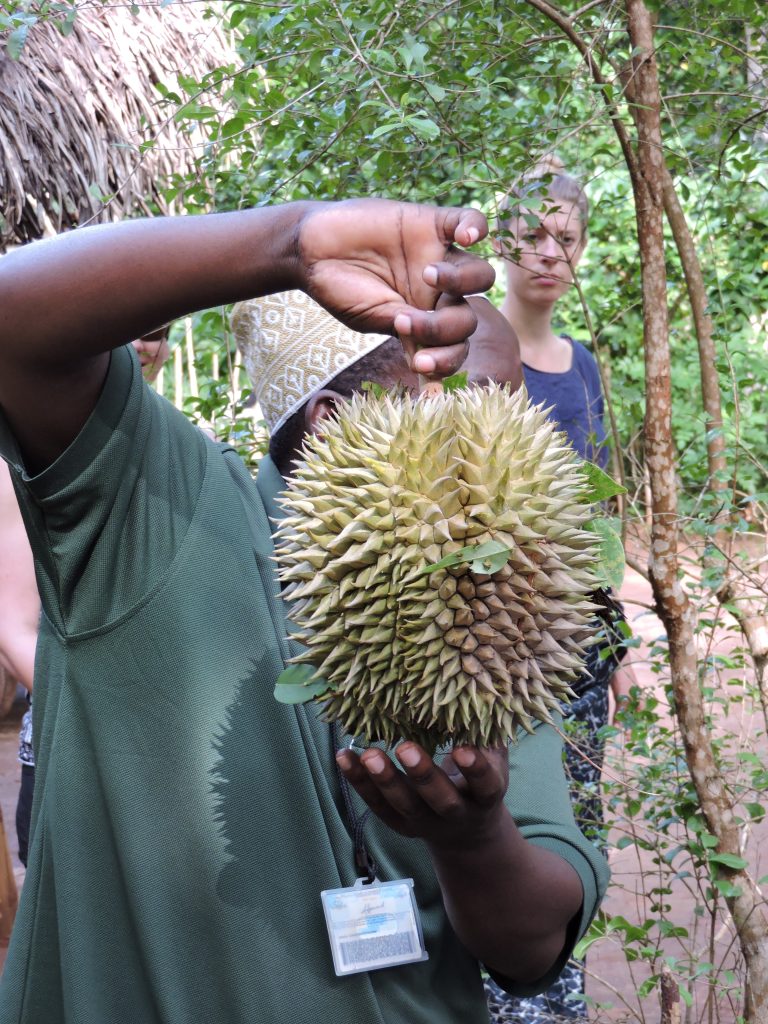
Spices.tz covers Tanzania's smaller spice lines that don't yet have their own dedicated commodity portal on this network: cinnamon, nutmeg & mace, and ginger. Clove, cardamom, black pepper, chilli and vanilla are each real, separate Tanzanian export crops with their own dedicated coverage -- see Clove.tz, Cardamom.tz, BlackPepper.tz, Chilli.tz and Vanilla.tz if that's what you're sourcing. This page covers what "grade," "moisture" and the relevant standards mean for the three crops genuinely published here -- see our Spices.tz overview for the wider Zanzibar/Tanzania spice-sector context.
.jpg)
Why this page covers exactly these three crops
Tanzania does not run a single "spice" export category -- clove, cardamom, black pepper, vanilla and chilli are each distinct crops with their own growing regions, trade classification and (on this network) dedicated portal. Cinnamon, nutmeg/mace and ginger are the crops that remain genuinely under this portal's "Other Spices" classification. Our own reporting is explicit that cinnamon, black pepper and nutmeg have historically grown together in Zanzibar's mixed smallholder "spice garden" plots -- intercropped with coconut and clove, picked for the tourist spice-tour trade, local kitchens and occasional specialty buyers -- without ever becoming a separate, large-volume export industry the way cloves did under the Zanzibar State Trade Corporation system. Ginger is geographically distinct (grown mainly on the mainland, in Kilimanjaro Region) but shares the same "Other Spices" classification and has its own, better-documented buyer relationships -- covered separately below.
Cinnamon
What Tanzania actually grows: Zanzibar's cinnamon is Cinnamomum verum (syn. C. zeylanicum), the species traded internationally as "Ceylon-type" or "true" cinnamon -- a different species from the cassia (C. cassia/C. burmannii) that dominates supermarket "cinnamon" in many markets. The Tanzania Spices Association/TanTrade's own Tanzania Spices Label materials state this explicitly: Tanzania produces Ceylon/true cinnamon, not cassia. This matters commercially, not just botanically -- see the coumarin point below.
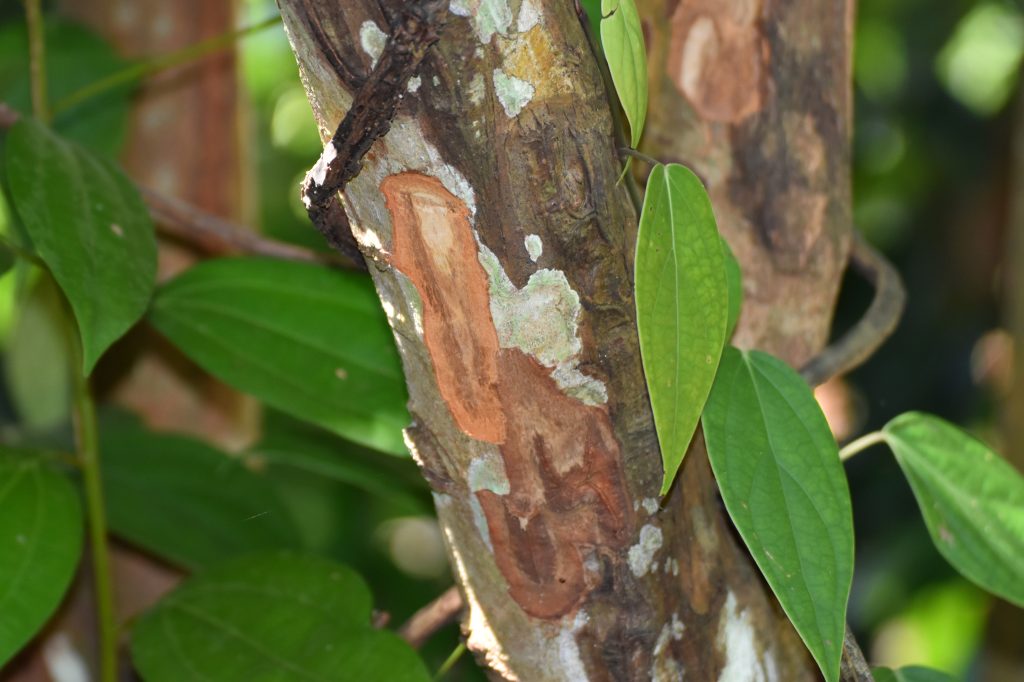

Standards: true cinnamon and cassia are governed by two different ISO standards, not one: ISO 6539 covers "Cinnamon, Sri Lankan type, Seychelles type and Madagascan type (Cinnamomum zeylanicum)" -- what Zanzibar grows -- while ISO 6538 separately covers cassia (Chinese, Indonesian and Vietnamese types). Zanzibar maintains its own compulsory national standard in the same lineage: ZNS 86:2024 ("Cinnamon (Cinnamomum zeylanicum Blume) -- Specification"), harmonised with the East African Community's EAS 1076:2022. We were able to confirm this standard's existence, number and scope from the Zanzibar Bureau of Standards' own published standards catalogue, but did not access its full requirements table -- so no specific moisture/ash figures from ZNS 86 itself are reproduced here.
A secondary commercial source (not independently verified against ISO 6539's primary text) states total ash limits of max. 5% for the Sri Lankan type and max. 7% for the Seychelles/Madagascan types, tested per ISO 928.
Grading: true cinnamon is traded by quill (rolled-bark) diameter. The most widely quoted grading convention internationally is Sri Lanka's own SLS 81:2021, which sorts quills into 13 grades by diameter, number of whole quills per kilogram, and degree of surface discolouration ("foxing") -- from Alba (≤6mm, the finest/thinnest) through C5 Special (7-9mm), C5 (10-12mm) and M5 (11-13mm) up to H3 (≤38mm). We flag this explicitly as a Sri Lankan national standard, not a Zanzibar-specific one -- but it is the de facto reference grid the true-cinnamon trade quotes against globally, and a Tanzanian cinnamon buyer should expect suppliers to reference it (or specify their own) rather than quote a bare "high grade."
Coumarin -- a genuine EU market-access advantage for true cinnamon: coumarin is a liver-relevant compound present at vastly different concentrations in the two cinnamon types -- cassia can run up to roughly 12,000mg/kg, while true/Ceylon cinnamon typically runs below 250mg/kg, often below 100mg/kg. The EU does not cap coumarin in raw cinnamon spice itself, but does cap it in finished bakery products under Regulation (EC) 1334/2008 (15mg/kg in fine bakery ware, 50mg/kg in traditional bakery ware) -- limits that are far easier to meet when the cinnamon ingredient is true/Ceylon-type to begin with. This is a real, quotable reason an EU buyer might specifically want Zanzibar's true cinnamon over a cassia-origin alternative.
Heavy metals: at its 48th session (10-14 November 2025, Rome), the Codex Alimentarius Commission adopted a new maximum level of 2.5mg/kg lead for "dried bark spices" (explicitly including cinnamon) under the General Standard for Contaminants and Toxins in Food (CXS 193-1995) -- a genuinely current (barely a year old at time of writing) and specific figure. A dedicated, full Codex quality/identity standard for cinnamon itself (as opposed to this contaminant limit) was still under development as of the 7th Codex Committee on Spices and Culinary Herbs (CCSCH7) -- so the contaminant limit exists ahead of a finished commodity standard.
Tanzania trade data -- genuinely disputed, not resolved here: our own published Cinnamon profile reports two sources that disagree sharply on scale -- ITC Trade Map data (via a 2018 EU-ACP TradeCom brief) shows Tanzania cinnamon exports near zero through the mid-2010s ($31,000 in 2012, effectively zero in 2015), while a commercial aggregator citing UN Comtrade shows $1,168,000 on 403 tonnes by 2019. We do not re-resolve that disagreement here -- see our full Spices.tz coverage for the detail. No production-volume, area or yield figure for Tanzanian cinnamon was found from any government or FAO source -- stated as an open gap, not filled.
Sources: Tanzania Spices (TASPA/TanTrade); Zanzibar Bureau of Standards compulsory standards catalogue (ZNS 86:2024); SLS 81:2021 grading summary; coumarin/cassia-vs-Ceylon comparison; Codex Alimentarius Commission, 48th session outcomes (CXS 193-1995 amendment).
Nutmeg & Mace
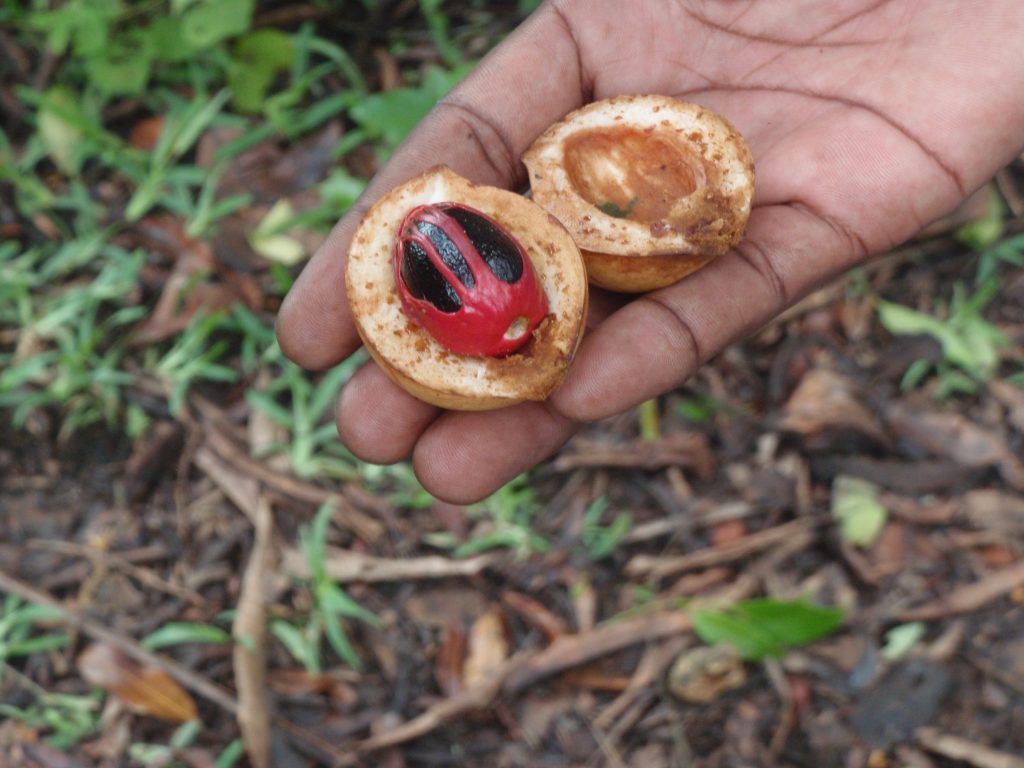
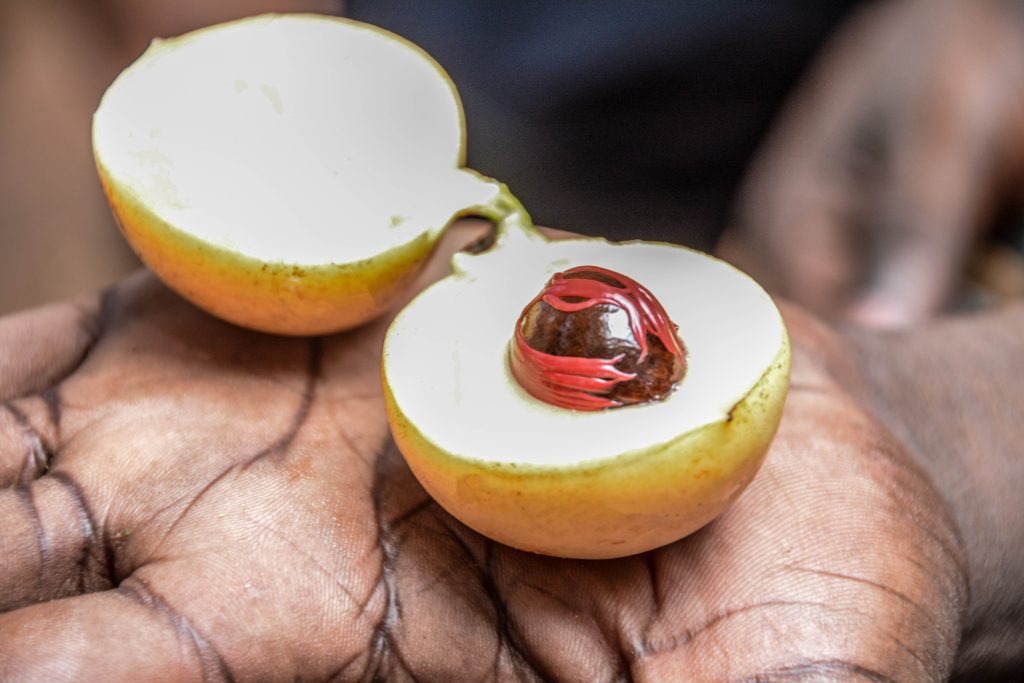
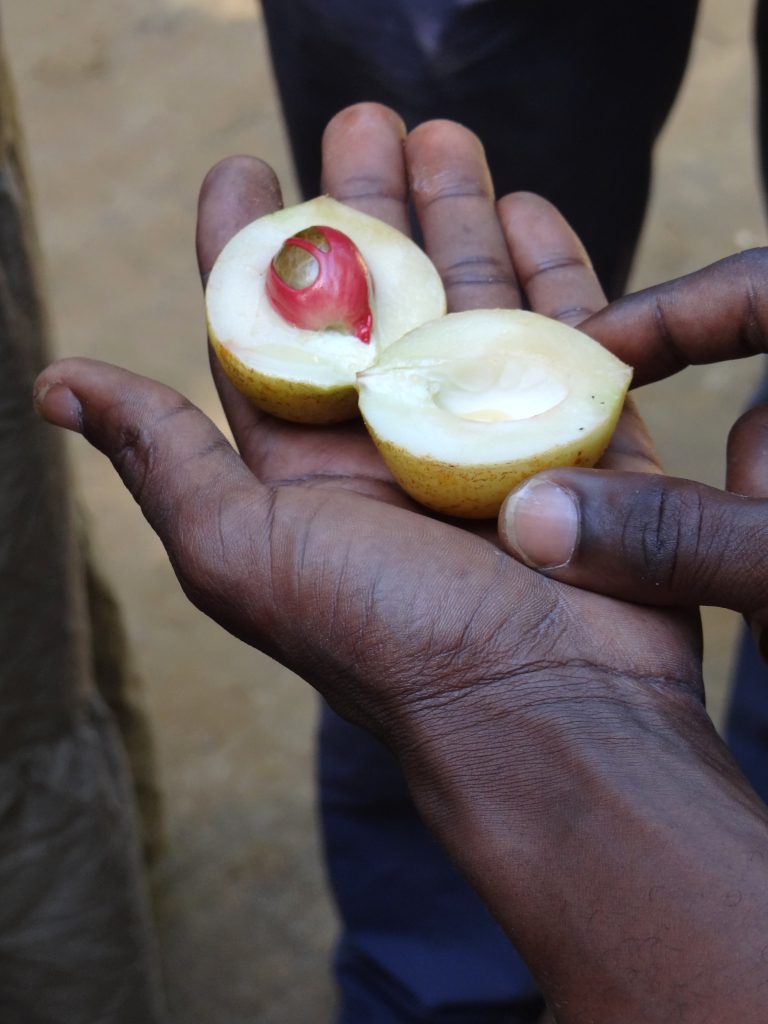
Nutmeg and mace are two separate spices from one fruit (Myristica fragrans): nutmeg is the dried kernel/seed; mace is the dried, lace-like aril that surrounds it. Both genuinely grow in Zanzibar's spice gardens, alongside cinnamon and pepper, as part of the same historical planting pattern traced to the government spice garden established at Kizimbani (outside Stone Town) under Sultan Said bin Sultan's 1820s-30s clove-economy push.
.jpg)

.jpg)
Standard: ISO 6577:2002, "Nutmeg, whole or broken, and mace, whole or in pieces (Myristica fragrans Houtt.) -- Specification," is the applicable international standard (an earlier edition dates to 1990). Zanzibar maintains its own compulsory equivalent, ZNS 586 ("Nutmeg, whole or broken, and mace, whole or in pieces -- Specification"), confirmed from the ZBS standards catalogue -- again, we could confirm the standard's existence and title but not its full numeric requirements.
An honest flag on moisture/ash figures: several secondary summaries circulating online attribute to ISO 6577 a moisture maximum of just 0.5%, a total ash maximum of 3%, and an acid-insoluble ash maximum of 10% -- that last figure would mean acid-insoluble ash could exceed total ash, which is not physically coherent, and a 0.5% moisture ceiling is far below what whole nutmeg kernels are ever actually measured at. We treat that combination as a garbled secondary source and do not repeat it as fact. What we can report with more confidence, from a peer-reviewed analytical study of nutmeg samples, is an empirically measured range: moisture 7.1-16.3% w/w (mean 10.2%) and volatile (essential) oil content 4.6-12.0mL/100g (mean 7.7) -- lab-measured typical composition, not a codified pass/fail limit from the standard itself.
Grading: whole nutmeg is traded by count-per-pound/kg convention -- common size grades include 80s, 110s and 130s (nuts per pound), or a mixed "ABCD" assortment of sizes; Grenada's own trade uses a different numbering convention ("55s" to "65s"). We found no Zanzibar-specific count-grading convention documented, so Tanzanian buyers/sellers should expect to specify or confirm which convention is in use rather than assume. Mace is graded primarily by colour and blade condition: top "Banda"-type mace runs bright orange to deep crimson/red; Java Estate mace is golden yellow with crimson streaks; Siauw/Ambon mace is orange and drier. A separate, botanically different product -- "Bombay" or "wild" mace, from Myristica malabarica, not M. fragrans -- is a known adulterant/substitute to screen for, not genuine mace. One commercial spec caps inferior/discoloured blades at 5% for premium mace; we flag this as a trade/commercial source, not a primary standard figure.
Aflatoxin & ochratoxin: nutmeg is one of the more frequently flagged commodities in EU spice-safety monitoring -- one academic analysis of EU RASFF notifications attributes roughly 18% of aflatoxin-B1 reports in the herbs/spices category to nutmeg specifically. Applicable EU limits (Regulation 2023/915) are the same spice-category figures already cited for chilli above: aflatoxin B1 5.0µg/kg, total aflatoxins 10.0µg/kg, and for nutmeg specifically, ochratoxin A 20µg/kg.
Tanzania-specific -- a genuine, stated gap, not an invented number: our own reporting on this is explicit: "We could not find reliable Tanzania-specific production or export-volume figures for cinnamon, pepper or nutmeg individually, and have not stated any." What exists instead, per that same reporting, is a smallholder "garden crop" pattern -- a few nutmeg trees intercropped with coconut and clove, picked for spice tours, local kitchens, and occasional one-off specialty-buyer relationships, with no ZSTC-style structured export channel the way clove has. We did not find a documented basis for singling out Pemba specifically (as opposed to Zanzibar/Unguja generally) as more historically significant for nutmeg the way Pemba is for clove -- our sources describe nutmeg as grown "in Zanzibar and Pemba" without drawing that distinction, so we do not assert it.
Sources: ISO 6577:2002 (listing/scope only, full text not independently read); Zanzibar Bureau of Standards compulsory standards catalogue (ZNS 586); a peer-reviewed nutmeg composition study (via ScienceDirect, "No more nutmegging with nutmeg"); EU Regulation 2023/915; an EU RASFF mycotoxin-notification analysis; and our own internal reporting, "Cinnamon, Nutmeg and Pepper Grow in Zanzibar Too -- They Just Never Became an Export Industry."
Ginger
Ginger (Zingiber officinale) is geographically distinct from the Zanzibar spice-garden cluster above -- Tanzania's leading ginger area is Same District, Kilimanjaro Region, on the mainland -- but it carries the same "Other Spices" (spice) classification on this network.
Standard: ISO 1003:2025, "Spices and condiments -- Whole/pieces and ground dried ginger (Zingiber officinale Roscoe) -- Specification," is the current international standard, superseding the withdrawn ISO 1003:2008 edition. Zanzibar maintains its own compulsory equivalent, ZNS 577, "Ginger -- Specification," confirmed from the ZBS catalogue; again, we could confirm the standard's existence but not its full requirements table. Trade distinguishes dried ginger by processing form -- whole unpeeled ("black" ginger), peeled/scraped ("white"/bleached), split, sliced, and ground/powder -- though we did not find granular size-grade cutoffs we could confidently attribute to the standard itself, and flag that as a gap rather than guess at specific dimensions.
Tanzania-specific -- already documented, not re-litigated here: our own published Ginger profile already reports this honestly: Same District is credited with growing most of Tanzania's ginger, but production-volume estimates disagree by one to two orders of magnitude across the sources we found (a FAOSTAT-attributed figure suggesting a decline from roughly 60,000 tonnes around 2008/09; a separate FAOSTAT-attributed commercial citation of roughly 1,100 tonnes for 2022; and a third aggregator figure of just 126 tonnes on 54 hectares for 2019) -- see our full Ginger coverage for that detail rather than a repeated/re-averaged figure here. What is better documented is live buyer activity: Same District smallholders have sold to Akida Group Ltd. (a subsidiary of a Ukrainian trading firm) reportedly seeking roughly two containers/week for Ukrainian/Western European markets, and a separate Kenyan buyer working through a Tanzanian intermediary has reportedly sought up to 200 tonnes/month.
HS code: dried ginger is traded under HS 0910.11 (neither crushed nor ground) and HS 0910.12 (crushed or ground) -- the same HS 0910 heading also covers saffron, turmeric and several other spices, so confirm the full extended code with your customs broker.
Contaminant limits -- another stated gap: the Codex Alimentarius Commission's November 2025 update to CXS 193-1995 added lead limits for dried bark spices (2.5mg/kg) and dried culinary herbs (2.0mg/kg) specifically -- but explicitly left rhizome/root spices, including ginger and turmeric, without a Codex lead limit as of that session. A buyer who needs a heavy-metal specification for Tanzanian ginger should request the supplier's own test data or set a limit via their own purchase specification, not assume a Codex figure exists by default.
Sources: ISO 1003:2025 (listing/scope only); Zanzibar Bureau of Standards compulsory standards catalogue (ZNS 577); our own internal reporting, Tanzania Ginger: Sourcing Guide; Codex Alimentarius Commission, 48th session outcomes.
Buyer specification checklist
This portal covers three distinct crops -- the single most important field in any RFQ is simply naming which one. Beyond that:
- Crop & species -- cinnamon (specify true/Ceylon-type C. verum vs cassia -- don't assume), nutmeg, mace, or ginger.
- Standard quoted -- e.g. ISO 6539 (true cinnamon) vs ISO 6538 (cassia); ISO 6577 (nutmeg/mace); ISO 1003 (ginger) -- or the Zanzibar ZNS equivalent if you need origin-specific compliance.
- Grade/form -- cinnamon quill diameter grade (e.g. per SLS 81:2021); nutmeg count-per-lb/kg or mace colour grade; ginger whole/peeled/split/ground.
- Moisture -- a target range; note the nutmeg-figure caution above before quoting a specific ISO number back to a supplier.
- Contaminant testing -- aflatoxin/ochratoxin certificate of analysis for nutmeg/mace in particular, given its flagged RASFF history; lead testing for cinnamon given the new Codex limit; note the absence of a Codex lead limit for ginger.
- Packaging & certification -- organic, fair-trade or other, if applicable, and who issued it.
- Destination & Incoterm -- see our Incoterms for Commodity Buyers guide.
Sample & inspection guidance
- Cinnamon -- quill colour (tan/light brown for true cinnamon vs the darker, thicker single-layer bark typical of cassia), thinness/snap, and a clean, sweet aroma rather than a harsh or musty one.
- Nutmeg -- kernel density/weight for size, a strong characteristic aroma on cutting, and freedom from visible mould or insect damage.
- Mace -- intact "blade" structure (not crumbled to fragments unless that's the form ordered), and colour consistent with the grade claimed (see colour notes above).
- Ginger -- firmness, absence of shrivelling or visible mould, and a pungent, clean aroma without off-notes.
- All four -- packaging condition (dry, intact, no pest activity) and freedom from foreign/extraneous matter.
A visual/aroma sample check is a screening step, not a substitute for laboratory testing -- moisture percentage, volatile oil content, and aflatoxin/ochratoxin/lead levels all require lab equipment to confirm, not inspection by eye. Our general Quality Inspection & Pre-Shipment Verification guide covers the wider pre-shipment inspection process that applies across commodities, including these three.

Full Spices.tz profile
Origins, the wider Zanzibar/Tanzania spice-basket context, and market/trade data with sources -- including why clove, cardamom, vanilla, black pepper and chilli are covered on their own dedicated portals instead.
Read the full profile →Suppliers
Trianon Spices
Spice processor and exporter with a factory in Muheza, Tanga Region, sourcing from 1,000+ smallholder farmers…

Viridium Tanzania Limited
Producer/exporter of gourmet and extract-grade vanilla beans, powder and cuts, plus cardamom, clove, chili and cinnamon,…

Zanj Spice Limited (1001 Organic)
Zanzibar spice production and trading company (established 2012) supervising the full chain from partner farms to…
Zanzibar State Trading Corporation (ZSTC)
Government parastatal (established as a state trading body in the 1960s) holding the legal monopoly on…
Horizon Spices Limited
Tanzania operations of Horizon Group, a multinational spice-aggregation company founded 2006 in Nigeria that pivoted into…
Blue Spices Zanzibar Ltd.
Zanzibar-registered spice trading company (est. 2023, Reg No Z0000186111) sourcing from small and medium farmers and…
Last reviewed 8 October 2026. Sources cited inline above; see also Data Sources and Methodology for how we handle disagreeing figures and unverifiable claims.