Tanzania Black Pepper: Sourcing Guide
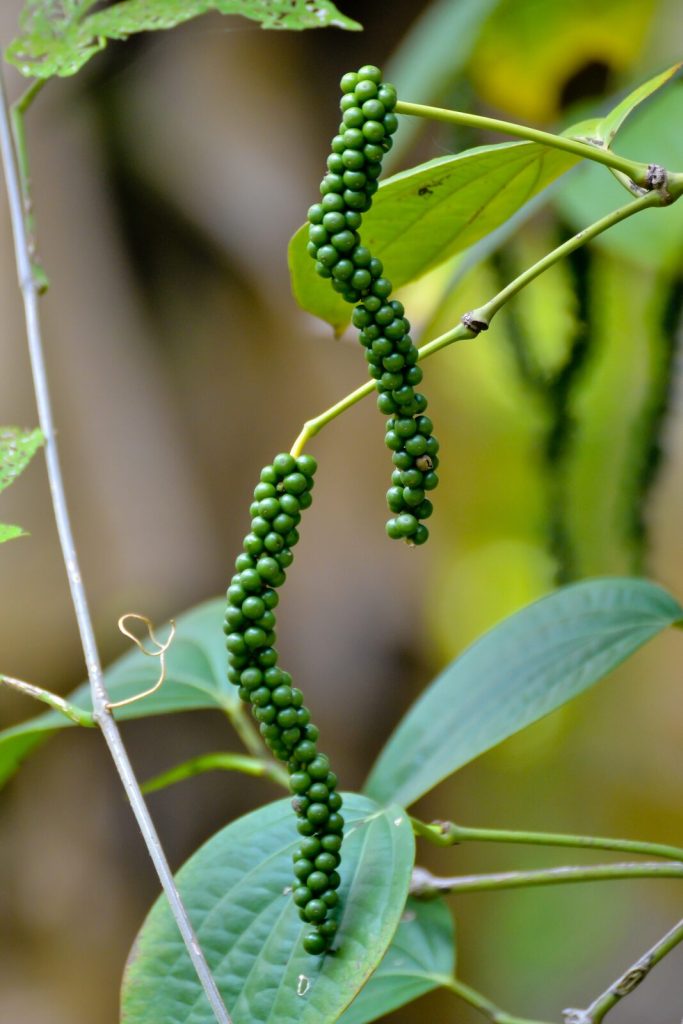
Overview
Black pepper is one of five spices explicitly named in Tanzania’s government-linked spice-sector development strategy (alongside cloves, ginger, cinnamon and cardamom), and has the best-documented growing story of the “other spices” beyond cloves, vanilla and cardamom — a specific Zanzibar/Pemba terroir, a named commercial buyer relationship, and a real, if imperfectly resolved, trade record.
Growing Regions
Pemba Island’s hillsides are the best-documented pepper-growing area, where vines are typically intercropped with coconut, cinnamon and clove trees; the island’s sandy soil is credited by specialty buyers with producing smaller, more intensely flavored peppercorns. An EU-certified-organic smallholder cooperative on Zanzibar supplies at least one named specialty importer. On the mainland, medium-sized pepper plantations are documented in Morogoro Region, typically intercropped with coffee or banana for shade.
Quality & Handling
A documented, Tanzania-specific quality problem: pepper is frequently harvested before full maturity or sun-dried on mats laid directly on the ground at the farm, creating a real contamination risk from dust or livestock — a 2017 field-research finding, not a historical footnote, and a concrete area where buyer-side inspection and post-harvest-handling investment could add value.
Trade Data
ITC Trade Map data (HS 0904) for 2012–2016 shows Tanzania’s world pepper/capsicum exports rising overall, with a notable outlier: $733,000 (2012), $165,000 (2013), a $14,812,000 spike in 2014 (unexplained in the source and not corroborated elsewhere — treat as an anomaly, not a trend), $598,000 (2015), $1,201,000 (2016). Exports to the EU specifically rose more than tenfold from 2015 to 2016 ($61,000 to $770,000). More recent UN Comtrade-derived data (via Selina Wamucii, 2024) shows roughly $2.38 million in export value on 738 tonnes — a global export ranking around #30 — with volume up sharply (+196% year-on-year) and a unit price near $3.23/kg (TZS 7,684/kg). A production figure of 436.7 tonnes in 2024 is cited from the same aggregator chain but has not been independently confirmed against FAOSTAT directly.
What We Don’t Know
We could not independently verify the 2014 export spike or the specific 2024 production figure against a primary government or FAOSTAT source — both are flagged here rather than silently smoothed over or omitted.
Current Market
No verified current market observation is available for this commodity yet.
Suppliers
East Africa Agro Supply
Bulk agricultural commodity exporter offering cashew nuts, coffee and spices, FOB Dar es Salaam. According to…
Viridium Tanzania Limited
Producer/exporter of gourmet and extract-grade vanilla beans, powder and cuts, plus cardamom, clove, chili and cinnamon.…
Zanj Spice Limited (1001 Organic)
Zanzibar spice production and trading company (established 2012) supervising the full chain from partner farms to…
Zanzibar State Trading Corporation (ZSTC)
Government parastatal (established as a state trading body in the 1960s) holding the legal monopoly on…
- REPOA Policy Brief PB 3/2018 — Harnessing the potential of Tanzania's exports competitiveness for spices — https://www.repoa.or.tz/wp-content/uploads/2020/07/Harnessing_the_potential_of_Tanzanias_exports.pdf — 2026-09-25
- Selina Wamucii — Tanzania Pepper Prices — https://www.selinawamucii.com/insights/prices/tanzania/pepper/ — 2026-09-25